Case study 01 — Clinical decision support
Catching redundant medical tests before they're ordered
Patients were getting the same test twice because a result from another facility never surfaced at the moment of ordering. I designed a check that flags it inside the EHR, and still lets the specialist decide.
- Client
- UpToDate · Wolters Kluwer
- Year
- 2017 · Waltham, MA
- My role
- Lead UX Designer
- Tools
- Axure
The problem
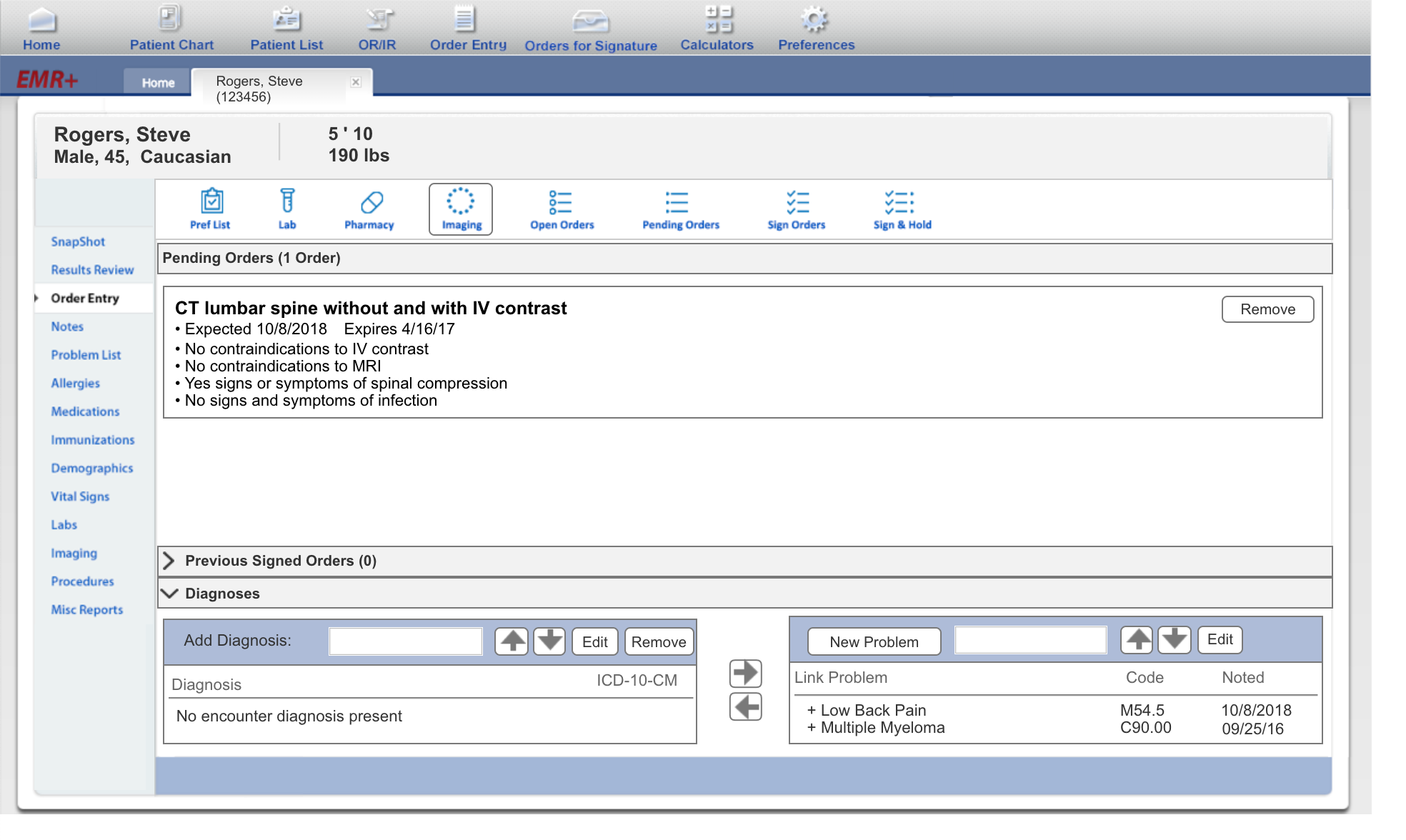
When a patient has had a test recently at a different facility, the ordering doctor or nurse often has no way to see it at the moment they order. The result is repeat testing: more burden on the patient, more cost for insurers, more exposure for the hospital.
The constraint: any fix had to respect clinical judgment. A hard block would be overridden, resented, or both.
How it works
Warn, don't block. Every override is captured, so the decision is accountable without being slowed down.
-
Step 1
Clinician orders a test
In the normal EHR ordering flow, nothing new to learn.
-
Step 2
System flags a recent result
Including tests performed at other facilities.
-
Step 3
Cancel, or reorder with a reason
The specialist keeps autonomy; they explain the circumstances.
-
Step 4
Reason saved to the record
Accountability for the hospital, and legal protection.
Three patient cases, one prototype
The prototype runs three imaging orders for low back pain through the same flow. Each lands on a different decision-support verdict.
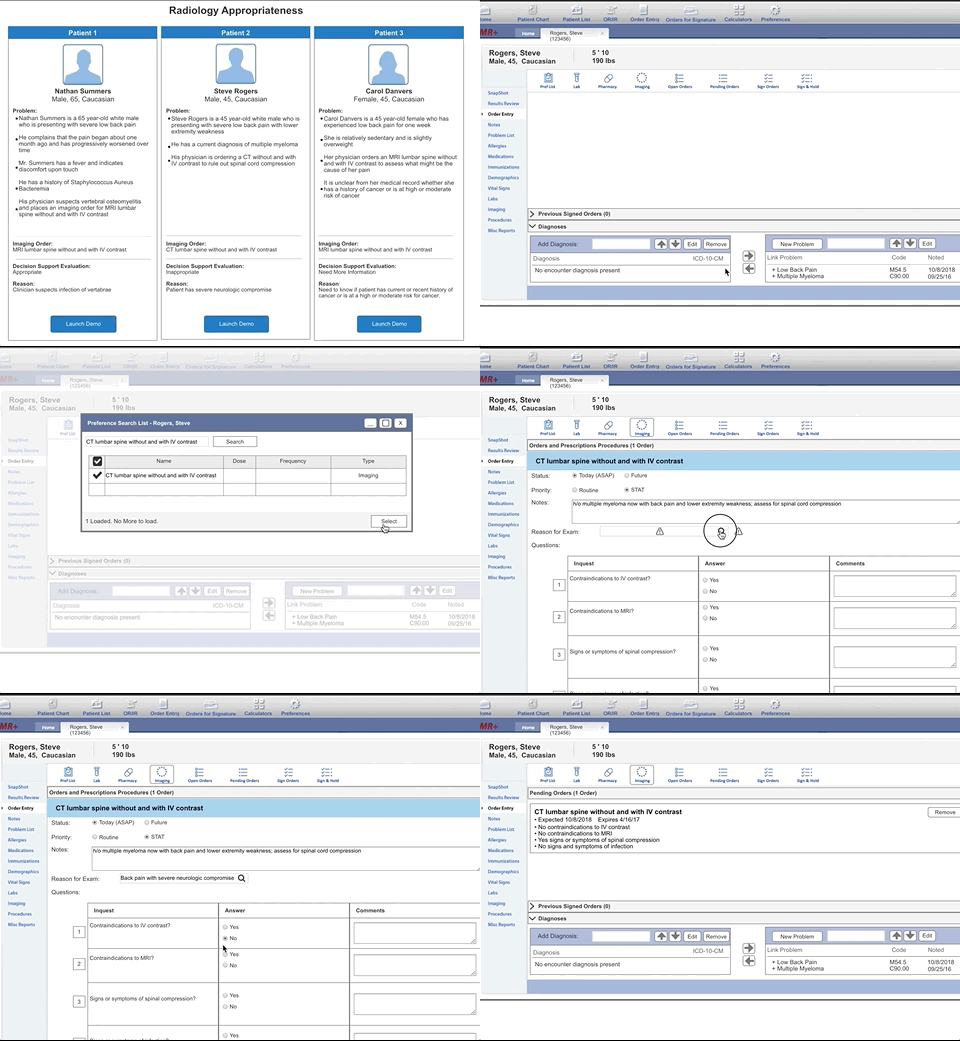
Patient 1 · Nathan Summers, 65
Appropriate
Severe low back pain, a fever, and a history of Staphylococcus aureus bacteremia. His physician suspects vertebral osteomyelitis and orders an MRI of the lumbar spine.
Why: the clinician suspects infection of the vertebrae.
Patient 2 · Steve Rogers, 45
Inappropriate
Severe low back pain with lower-extremity weakness and a current multiple myeloma diagnosis. His physician orders a CT of the lumbar spine to rule out spinal cord compression.
Why: the patient has severe neurologic compromise.
Patient 3 · Carol Danvers, 45
Need more information
A week of low back pain; she is sedentary and slightly overweight. Her physician orders an MRI of the lumbar spine to find the cause.
Why: the record doesn’t show whether she has a history of cancer or is at moderate or high risk.
Outcome
This was a concept, delivered as an Axure prototype that walks through the flow for each of the three personas. It shows how a redundancy check can sit inside the ordering flow without taking the decision away from the clinician.
Next case study
Moving Spotfire's settings home